


Page 56 - WEF Reoprt 2020
P. 56
as well as in the ocean. Up to 80% of the   deteriorations in security. Indigenous
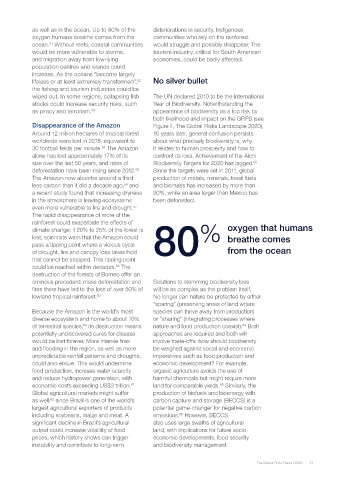
            oxygen humans breathe comes from the       communities who rely on the rainforest
            ocean.  Without reefs, coastal communities   would struggle and possibly disappear. The
                  51
            would be more vulnerable to storms,        tourism industry, critical for South American
            and migration away from low-lying          economies, could be badly affected.
            population centres and islands could
            increase. As the oceans “become largely
            lifeless or at least extremely transformed”,    No silver bullet
                                                 52
            the fishing and tourism industries could be
            wiped out. In some regions, collapsing fish   The UN declared 2010 to be the International
            stocks could increase security risks, such   Year of Biodiversity. Notwithstanding the
            as piracy and terrorism. 53                appearance of biodiversity as a top risk by
                                                       both likelihood and impact on the GRPS (see
            Disappearance of the Amazon                Figure II, The Global Risks Landscape 2020),
            Around 12 million hectares of tropical forest   10 years later, general confusion persists
            worldwide were lost in 2018, equivalent to   about what precisely biodiversity is, why
            30 football fields per minute.  The Amazon   it relates to human prosperity and how to
                                     54
            alone has lost approximately 17% of its    confront its loss. Achievement of the Aichi
            size over the last 50 years, and rates of   Biodiversity Targets for 2020 has lagged.
                                                                                          63
            deforestation have been rising since 2012.    Since the targets were set in 2011, global
                                                 55
            The Amazon now absorbs around a third      production of metals, minerals, fossil fuels
            less carbon than it did a decade ago,  and   and biomass has increased by more than
                                             56
            a recent study found that increasing dryness   20%, while an area larger than Mexico has
            in the atmosphere is leaving ecosystems    been deforested.
            even more vulnerable to fire and drought.
                                                57
            The rapid disappearance of more of the
            rainforest could exacerbate the effects of
            climate change: if 20% to 25% of the forest is                       oxygen that humans
            lost, scientists warn that the Amazon could   80           % breathe comes
            pass a tipping point where a vicious cycle
            of drought, fire and canopy loss takes hold                          from the ocean
            that cannot be stopped. This tipping point
            could be reached within decades.  The
                                          58
            destruction of the forests of Borneo offer an
            ominous precedent: mass deforestation and   Solutions to stemming biodiversity loss
            fires there have led to the loss of over 50% of   will be as complex as the problem itself.
            lowland tropical rainforest. 59            No longer can nature be protected by either
                                                       “sparing” (preserving areas of land where
            Because the Amazon is the world’s most     species can thrive away from production)
            diverse ecosystem and home to about 10%    or “sharing” (integrating processes where
            of terrestrial species,  its destruction means   nature and food production coexist).  Both
                              60
                                                                                      64
            potentially undiscovered cures for disease   approaches are required and both will
            would be lost forever. More intense fires   involve trade-offs: how should biodiversity
            and flooding in the region, as well as more   be weighed against social and economic
            unpredictable rainfall patterns and droughts,   imperatives such as food production and
            could also ensue. This would undermine     economic development? For example,
            food production, increase water scarcity   organic agriculture avoids the use of
            and reduce hydropower generation, with     harmful chemicals but might require more
            economic costs exceeding US$3 trillion.    land for comparable yields.  Similarly, the
                                               61
                                                                              65
            Global agricultural markets might suffer   production of biofuels and bioenergy with
            as well,  since Brazil is one of the world’s   carbon capture and storage (BECCS) is a
                   62
            largest agricultural exporters of products   potential game-changer for negative carbon
            including soybeans, maize and meat. A      emissions.  However, BECCS
                                                                66
            significant decline in Brazil’s agricultural   also uses large swaths of agricultural
            output could increase volatility of food    land, with implications for future socio-
            prices, which history shows can trigger    economic developments, food security
            instability and contribute to long-term    and biodiversity management.


                                                                                           The Global Risks Report 2020  51

