


Page 53 - WEF Reoprt 2020
P. 53
50              %         modern drugs                      crisis: these microscopic plants that drift

                                                                      at the sea surface absorb carbon dioxide
                                    developed from
                                                                      on a scale comparable to the world’s
                                    natural products
                                                                      forests,  and they are threatened by
                                                                            29
                                                                      warming oceans. 30
                                                                      Business risk
                                                                      The destruction of nature will inevitably
                           Exacerbation of climate change             impact bottom lines—for example,
                           Terrestrial and marine biodiversity together   through reduced fish stocks disrupting
                           support the reduction of greenhouse gas    commodity supply chains, economic
                           emissions and the conservation of carbon   losses from disasters such as flooding,
                           sinks, sequestering 5.6 gigatonnes of      and the loss of potential new sources
                           carbon per year—the equivalent of 60% of   of medicine. Extractives, construction,
                           global human-driven emissions. The health   energy, fashion and textiles are among
                           of ecosystems that sequester carbon can    the sectors especially vulnerable to
                           depend on individual species: for example,   ecological destruction.  All businesses
                                                                                          31
                           endangered forest elephants are vital to   should account for ecological risks to their
                           the health of Central Africa’s rainforests.   operations and reputations, yet few do: a
                           Collapse of this ecosystem could release   recent study of Fortune 500 companies
                           3 billion tons of carbon, the equivalent   found that nearly half mentioned biodiversity
                           of France’s emissions for 27 years.        in their sustainability reports, but only five
                                                          28
                           Phytoplankton provide another example      set specific, measurable and timebound
                           of how depletion of species and ecosystems   targets.  Nature-related risks are
                                                                            32
                           could exponentially worsen the climate     undervalued in business decision-making.


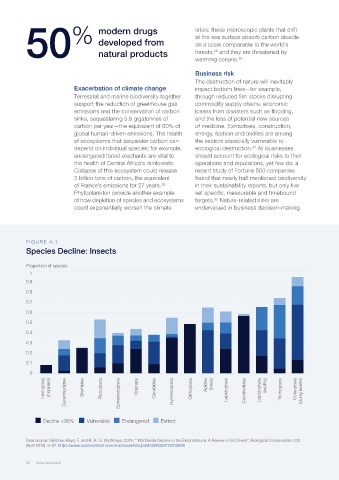
          FIG U RE 4 .1
          Species Decline: Insects


          Proportion of species
            1
          0.9
          0.8

          0.7
          0.6
          0.5
          0.4
          0.3

          0.2
          0.1
            0
                 Hemiptera  (hoppers)  Cerambycidae  Sirphidae  Plecoptera  Ephemeroptera  Odonata  Carabidae  Hymenoptera  Orthoptera  Apidae  (bees)  Lepidoptera  Coccinelidae  Lepidoptera  (moths)  Trichoptera  Coleoptera  (dung beetle)


                Decline <30%   Vulnerable   Endangered   Extinct


          Data source: Sánchez-Bayo, F. and K. A. G. Wyckhuys. 2019. “ Worldwide Decline of the Entomofauna: A Review of its Drivers”.  Biological Conservation 232
          (April 2019): 8–27. https://www.sciencedirect.com/science/article/pii/S0006320718313636


          48  Save the Axolotl

