


Page 51 - WEF Reoprt 2020
P. 51
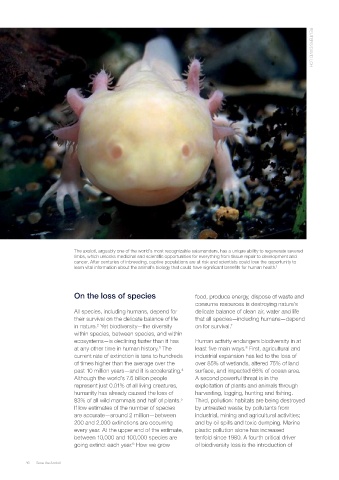
The axolotl, arguably one of the world’s most recognizable salamanders, has a unique ability to regenerate severed   REUTERS/DAVID LOH
                           limbs, which unlocks medicinal and scientific opportunities for everything from tissue repair to development and
                           cancer. After centuries of inbreeding, captive populations are at risk and scientists could lose the opportunity to
                           learn vital information about the animal’s biology that could have significant benefits for human health. 1


                           On the loss of species                     food, produce energy, dispose of waste and
                                                                      consume resources is destroying nature’s
                           All species, including humans, depend for   delicate balance of clean air, water and life
                           their survival on the delicate balance of life   that all species—including humans—depend
                           in nature.  Yet biodiversity—the diversity   on for survival. 7
                                   2
                           within species, between species, and within
                           ecosystems—is declining faster than it has   Human activity endangers biodiversity in at
                           at any other time in human history.  The   least five main ways.  First, agricultural and
                                                                                       8
                                                         3
                           current rate of extinction is tens to hundreds   industrial expansion has led to the loss of
                           of times higher than the average over the   over 85% of wetlands, altered 75% of land
                           past 10 million years—and it is accelerating.    surface, and impacted 66% of ocean area.
                                                                 4
                           Although the world’s 7.6 billion people    A second powerful threat is in the
                           represent just 0.01% of all living creatures,   exploitation of plants and animals through
                           humanity has already caused the loss of    harvesting, logging, hunting and fishing.
                           83% of all wild mammals and half of plants.    Third, pollution: habitats are being destroyed
                                                                5
                           If low estimates of the number of species   by untreated waste; by pollutants from
                           are accurate—around 2 million—between      industrial, mining and agricultural activities;
                           200 and 2,000 extinctions are occurring    and by oil spills and toxic dumping. Marine
                           every year. At the upper end of the estimate,   plastic pollution alone has increased
                           between 10,000 and 100,000 species are     tenfold since 1980. A fourth critical driver
                           going extinct each year.  How we grow      of biodiversity loss is the introduction of
                                                6

          46  Save the Axolotl

