


Page 54 - WEF Reoprt 2020
P. 54
Indigenous community livelihood
            and culture risks
            Indigenous communities often rely on their
            diverse local ecosystems for food and other
            resources: for example, 60% of the world’s
            indigenous population uses largely plant-
            based traditional medicines.  And the rest of
                                     33
            humanity relies on indigenous communities
            to be stewards of ecosystems, protecting
            and preserving environmental resources.
            Indigenous peoples comprise less than 5%
            of the world’s population but protect 80% of
            its biodiversity.
                         34
            Beyond these known risks are unknowable
            losses—the risk of losing species we have
            not yet discovered that could have been
            domesticated for crops or given rise to new
            medicinal breakthroughs. For example,
            the ocean represents a “virtually untapped
            resource for discovery of novel chemicals
            with pharmaceutical potential,”  and recent
                                       35
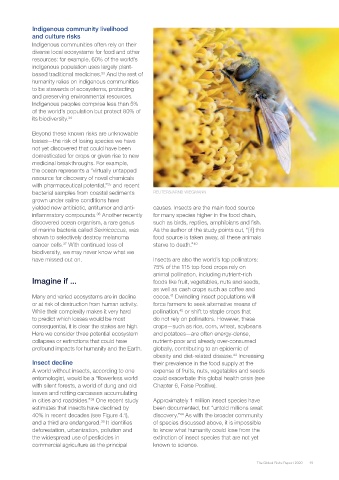
            bacterial samples from coastal sediments   REUTERS/ARND WIEGMANN
            grown under saline conditions have
            yielded new antibiotic, antitumor and anti-  causes. Insects are the main food source
            inflammatory compounds.  Another recently   for many species higher in the food chain,
                                   36
            discovered ocean organism, a rare genus    such as birds, reptiles, amphibians and fish.
            of marine bacteria called Serinicoccus, was   As the author of the study points out, “[if] this
            shown to selectively destroy melanoma      food source is taken away, all these animals
            cancer cells.  With continued loss of      starve to death.”
                                                                     40
                       37
            biodiversity, we may never know what we
            have missed out on.                        Insects are also the world’s top pollinators:
                                                       75% of the 115 top food crops rely on
                                                       animal pollination, including nutrient-rich
            Imagine if ...                             foods like fruit, vegetables, nuts and seeds,

                                                       as well as cash crops such as coffee and
            Many and varied ecosystems are in decline   cocoa.  Dwindling insect populations will
                                                             41
            or at risk of destruction from human activity.   force farmers to seek alternative means of
            While their complexity makes it very hard   pollination,  or shift to staple crops that
                                                                42
            to predict which losses would be most      do not rely on pollinators. However, these
            consequential, it is clear the stakes are high.   crops—such as rice, corn, wheat, soybeans
            Here we consider three potential ecosystem   and potatoes—are often energy-dense,
            collapses or extinctions that could have   nutrient-poor and already over-consumed
            profound impacts for humanity and the Earth.   globally, contributing to an epidemic of
                                                       obesity and diet-related disease.  Increasing
                                                                                   43
            Insect decline                             their prevalence in the food supply at the
            A world without insects, according to one   expense of fruits, nuts, vegetables and seeds
            entomologist, would be a “flowerless world   could exacerbate this global health crisis (see
            with silent forests, a world of dung and old   Chapter 6, False Positive).
            leaves and rotting carcasses accumulating
            in cities and roadsides.”  One recent study   Approximately 1 million insect species have
                                 38
            estimates that insects have declined by    been documented, but “untold millions await
            40% in recent decades (see Figure 4.1),    discovery.”  As with the broader community
                                                                44
            and a third are endangered.  It identifies   of species discussed above, it is impossible
                                    39
            deforestation, urbanization, pollution and    to know what humanity could lose from the
            the widespread use of pesticides in        extinction of insect species that are not yet
            commercial agriculture as the principal    known to science.


                                                                                           The Global Risks Report 2020  49

