


Page 79 - WEF Reoprt 2020
P. 79
The slowing of                             However, strained health systems are leading
                           health progress                            to worrying trends. Gains in lifespan and
                                                                      healthspan (the number of years spent in
                           Global investments in health in recent     good health) seem to be slowing in both
                           decades have yielded substantial gains to   developed and developing countries.  For
                                                                                                     4
                           both longevity and quality of life. Over the   example, recent data published by the
                           long history of our species, the average   Centers for Disease Control and Prevention
                           life expectancy at birth for people in most   shows that US life expectancy declined in
                           societies ranged from 20 to 50 years. Since   2017 for the third year in a row, the longest
                           1950, this has improved significantly—to    sustained drop for a century—since the
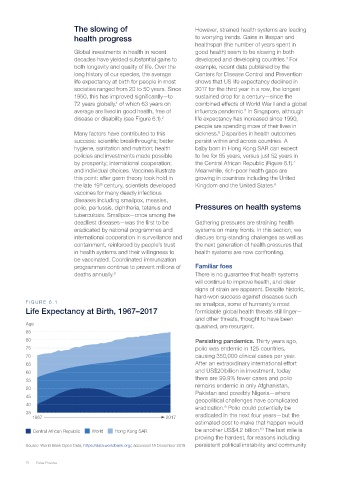
                           72 years globally,  of which 63 years on   combined effects of World War I and a global
                                          1
                           average are lived in good health, free of   influenza pandemic.  In Singapore, although
                                                                                       5
                           disease or disability (see Figure 6.1). 2  life expectancy has increased since 1990,
                                                                      people are spending more of their lives in
                           Many factors have contributed to this      sickness.  Disparities in health outcomes
                                                                              6
                           success: scientific breakthroughs; better   persist within and across countries. A
                           hygiene, sanitation and nutrition; health   baby born in Hong Kong SAR can expect
                           policies and investments made possible     to live for 85 years, versus just 52 years in
                           by prosperity; international cooperation;   the Central African Republic (Figure 6.1).
                                                                                                        7
                           and individual choices. Vaccines illustrate   Meanwhile, rich-poor health gaps are
                           this point: after germ theory took hold in   growing in countries including the United
                           the late 19  century, scientists developed   Kingdom and the United States. 8
                                    th
                           vaccines for many deadly infectious
                           diseases including smallpox, measles,
                           polio, pertussis, diphtheria, tetanus and   Pressures on health systems
                           tuberculosis. Smallpox—once among the
                           deadliest diseases—was the first to be     Gathering pressures are straining health
                           eradicated by national programmes and      systems on many fronts. In this section, we
                           international cooperation in surveillance and   discuss long-standing challenges as well as
                           containment, reinforced by people’s trust   the next generation of health pressures that
                           in health systems and their willingness to   health systems are now confronting.
                           be vaccinated. Coordinated immunization
                           programmes continue to prevent millions of   Familiar foes
                           deaths annually. 3                         There is no guarantee that health systems
                                                                      will continue to improve health, and clear
                                                                      signs of strain are apparent. Despite historic,
                                                                      hard-won success against diseases such
          FIG U RE 6 .1                                               as smallpox, some of humanity’s most
          Life Expectancy at Birth, 1967–2017                         formidable global health threats still linger—
                                                                      and other threats, thought to have been
          Age
                                                                      quashed, are resurgent.
          85
          80                                                          Persisting pandemics. Thirty years ago,
          75                                                          polio was endemic in 125 countries,
          70                                                          causing 350,000 clinical cases per year.
          65                                                          After an extraordinary international effort
          60                                                          and US$20 billion in investment, today
          55                                                          there are 99.9% fewer cases and polio
          50                                                          remains endemic in only Afghanistan,
          45                                                          Pakistan and possibly Nigeria—where
                                                                      geopolitical challenges have complicated
          40                                                          eradication.  Polio could potentially be
                                                                                9
          35
            1967                                           2017       eradicated in the next four years—but the
                                                                      estimated cost to make that happen would
                                                                                            10
             Central African Republic  World  Hong Kong SAR           be another US$4.2 billion.  The last mile is
                                                                      proving the hardest, for reasons including
          Source: World Bank Open Data, https://data.worldbank.org/,  accessed 15 December 2019.  persistent political instability and community


          74  False Positive

