


Page 94 - WEF Reoprt 2020
P. 94
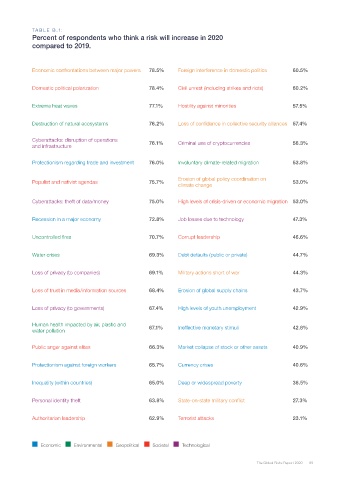
TA BLE  B .1:
            Percent of respondents who think a risk will increase in 2020
            compared to 2019.


            Economic confrontations between major powers  78.5%  Foreign interference in domestic politics  60.5%


            Domestic political polarization          78.4%      Civil unrest (including strikes and riots)  60.2%

            Extreme heat waves                       77.1%      Hostility against minorities            57.5%


            Destruction of natural ecosystems        76.2%      Loss of confidence in collective security alliances  57.4%


            Cyberattacks: disruption of operations    76.1%     Criminal use of cryptocurrencies        56.3%
            and infrastructure


            Protectionism regarding trade and investment  76.0%  Involuntary climate-related migration  53.8%

                                                                Erosion of global policy coordination on
            Populist and nativist agendas            75.7%                                              53.0%
                                                                climate change


            Cyberattacks: theft of data/money        75.0%      High levels of crisis-driven or economic migration  53.0%

            Recession in a major economy             72.8%      Job losses due to technology            47.3%


            Uncontrolled fires                       70.7%      Corrupt leadership                      46.6%


            Water crises                             69.3%      Debt defaults (public or private)       44.7%


            Loss of privacy (to companies)           69.1%      Military actions short of war           44.3%


            Loss of trust in media/information sources  68.4%   Erosion of global supply chains         43.7%


            Loss of privacy (to governments)         67.4%      High levels of youth unemployment       42.9%

            Human health impacted by air, plastic and
            water pollution                          67.1%      Ineffective monetary stimuli            42.8%

            Public anger against elites              66.3%      Market collapse of stock or other assets  40.9%


            Protectionism against foreign workers    65.7%      Currency crises                         40.6%


            Inequality (within countries)            65.0%      Deep or widespread poverty              36.5%


            Personal identity theft                  63.8%      State-on-state military conflict        27.3%


            Authoritarian leadership                 62.9%      Terrorist attacks                       23.1%


               Economic    Environmental  Geopolitical  Societal  Technological


                                                                                           The Global Risks Report 2020  89

