


Page 42 - WEF Reoprt 2020
P. 42
decade.  Far-reaching policies will be
                   76
            needed to transform industrial
            processes, transport, agriculture and
            land-use, alongside changes in consumer
            behaviours to scale the necessary
            critical solutions. 77

            As policies shift and societies transition,
            options must be assessed holistically
            because disorderly transition could
            potentially exacerbate impacts with short-
            sighted responses. For example, materials
            needed for low-carbon technologies such
            as nickel, copper, cobalt and manganese
            could be mined from the seabed—but the
            impacts of deep-sea mining on ecosystems
            and ocean health could offset its benefits.
                                                 78
            Likewise, the deployment of bioenergy with
            carbon capture and storage could require
            up to 700 mega hectares (an area twice
            the size of India) for bioenergy crops by the
            end of the century —and at a time when
                             79
            the global population may have reached
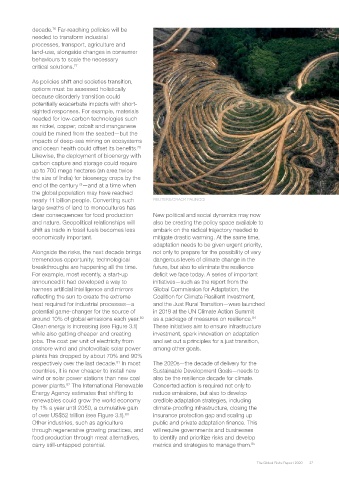
            nearly 11 billion people. Converting such   REUTERS/CRACK PALINGGI
            large swaths of land to monocultures has
            clear consequences for food production     New political and social dynamics may now
            and nature. Geopolitical relationships will   also be creating the policy space available to
            shift as trade in fossil fuels becomes less   embark on the radical trajectory needed to
            economically important.                    mitigate drastic warming. At the same time,
                                                       adaptation needs to be given urgent priority,
            Alongside the risks, the next decade brings   not only to prepare for the possibility of very
            tremendous opportunity; technological      dangerous levels of climate change in the
            breakthroughs are happening all the time.   future, but also to eliminate the resilience
            For example, most recently, a start-up     deficit we face today. A series of important
            announced it had developed a way to        initiatives—such as the report from the
            harness artificial intelligence and mirrors   Global Commission for Adaptation, the
            reflecting the sun to create the extreme   Coalition for Climate Resilient Investment,
            heat required for industrial processes—a   and the Just Rural Transition—were launched
            potential game-changer for the source of   in 2019 at the UN Climate Action Summit
            around 10% of global emissions each year.    as a package of measures on resilience.
                                                  80
                                                                                          84
            Clean energy is increasing (see Figure 3.1)   These initiatives aim to ensure infrastructure
            while also getting cheaper and creating    investment, spark innovation on adaptation
            jobs. The cost per unit of electricity from   and set out a principles for a just transition,
            onshore wind and photovoltaic solar power   among other goals.
            plants has dropped by about 70% and 90%
            respectively over the last decade.  In most   The 2020s—the decade of delivery for the
                                          81
            countries, it is now cheaper to install new   Sustainable Development Goals—needs to
            wind or solar power stations than new coal   also be the resilience decade for climate.
            power plants.  The International Renewable   Concerted action is required not only to
                        82
            Energy Agency estimates that shifting to   reduce emissions, but also to develop
            renewables could grow the world economy    credible adaptation strategies, including
            by 1% a year until 2050, a cumulative gain   climate-proofing infrastructure, closing the
            of over US$52 trillion (see Figure 3.1).    insurance protection gap and scaling up
                                             83
            Other industries, such as agriculture      public and private adaptation finance. This
            through regenerative growing practices, and   will require governments and businesses
            food production through meat alternatives,   to identify and prioritize risks and develop
            carry still-untapped potential.            metrics and strategies to manage them. 85


                                                                                           The Global Risks Report 2020  37

