


Page 36 - WEF Reoprt 2020
P. 36
Stress on ecosystems                       resource extraction,  all of which could
                                                                        22
            Oceans are getting warmer, stormier        cause tension between countries already
            and more acidic, impacting the health of   at odds over unresolved maritime and land
            sensitive marine ecosystems such as coral   boundaries (see Chapter 1, Global Risks
            reefs. As glaciers and ice sheets melt,    2020).  According to the UN, water was
                                                            23
            low-lying geographies will flood;  indeed,   a major factor in conflict in 45 countries
                                        14
            by 2050, three times more people will be   in 2017; disputes between upstream and
            impacted than previously thought.  This    downstream areas will likely intensify.
                                                                                       24
                                         15
            risk was explored in detail in the 2019    And as transition to a more decentralized,
            Global Risks Report chapter Fight or       renewable energy economy changes
            Flight, which examined the intersection of   geopolitical equations and creates new
            rapid urbanization and rising sea levels.   vulnerabilities for certain states and regions,
            Additionally, a scenario in which ice-cap   states’ relative position in the international
            melt creates disruption to the Gulf Stream   system will shift as well. 25
            could cause further ecosystem disorder,
            as well as major change in the pattern of
            severe weather perils. Another significant
            unknown risk relates to the potential thawing   US$
            of permafrost—frozen soil around the poles
            that stores nearly twice as much carbon as
            the atmosphere currently holds.  If the soil
                                        16
            thaws, this carbon could be released with
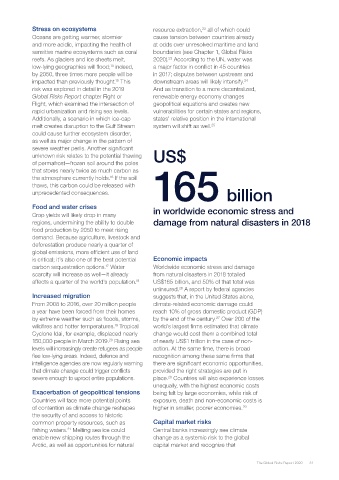
            unprecedented consequences.                165 billion
            Food and water crises                      in worldwide economic stress and
            Crop yields will likely drop in many
            regions, undermining the ability to double   damage from natural disasters in 2018
            food production by 2050 to meet rising
            demand. Because agriculture, livestock and
            deforestation produce nearly a quarter of
            global emissions, more efficient use of land
            is critical; it’s also one of the best potential   Economic impacts
            carbon sequestration options.  Water       Worldwide economic stress and damage
                                      17
            scarcity will increase as well—it already   from natural disasters in 2018 totalled
            affects a quarter of the world’s population. 18  US$165 billion, and 50% of that total was
                                                       uninsured.  A report by federal agencies
                                                                26
            Increased migration                        suggests that, in the United States alone,
            From 2008 to 2016, over 20 million people   climate-related economic damage could
            a year have been forced from their homes   reach 10% of gross domestic product (GDP)
            by extreme weather such as floods, storms,   by the end of the century.  Over 200 of the
                                                                             27
            wildfires and hotter temperatures.  Tropical   world’s largest firms estimated that climate
                                         19
            Cyclone Idai, for example, displaced nearly   change would cost them a combined total
            150,000 people in March 2019.  Rising sea   of nearly US$1 trillion in the case of non-
                                       20
            levels will increasingly create refugees as people   action. At the same time, there is broad
            flee low-lying areas. Indeed, defence and   recognition among these same firms that
            intelligence agencies are now regularly warning   there are significant economic opportunities,
            that climate change could trigger conflicts   provided the right strategies are put in
            severe enough to uproot entire populations.  place.  Countries will also experience losses
                                                            28
                                                       unequally, with the highest economic costs
            Exacerbation of geopolitical tensions      being felt by large economies, while risk of
            Countries will face more potential points   exposure, death and non-economic costs is
            of contention as climate change reshapes   higher in smaller, poorer economies. 29
            the security of and access to historic
            common property resources, such as         Capital market risks
            fishing waters.  Melting sea ice could     Central banks increasingly see climate
                         21
            enable new shipping routes through the     change as a systemic risk to the global
            Arctic, as well as opportunities for natural   capital market and recognize that


                                                                                           The Global Risks Report 2020  31

