


Page 27 - WEF Reoprt 2020
P. 27
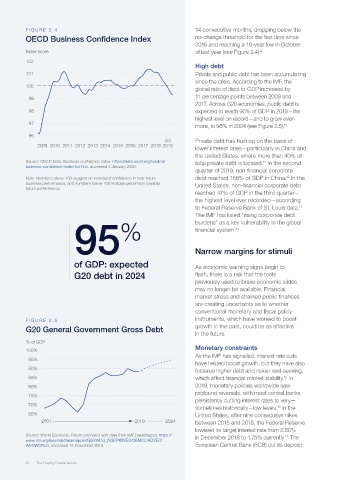
FIG U RE 2 .4                                               14 consecutive months, dropping below the
          OECD Business Confidence Index                               no-change threshold for the first time since
                                                                      2016 and reaching a 10-year low in October
          Index score                                                 of last year (see Figure 2.4). 9
          102
                                                                      High debt
          101                                                         Private and public debt has been accumulating
                                                                      since the crisis. According to the IMF, the
          100
                                                                      global ratio of debt-to-GDP increased by
           99                                                         11 percentage points between 2009 and
                                                                      2017. Across G20 economies, public debt is
           98                                                         expected to reach 90% of GDP in 2019—the
                                                                      highest level on record—and to grow even
           97
                                                                      more, to 95% in 2024 (see Figure 2.5). 10
           96
                                                           Oct        Private debt has built up on the basis of
              2009 2010 2011 2012 2013 2014 2015 2016 2017 2018 2019
                                                                      lower interest rates—particularly in China and
                                                                      the United States, where more than 40% of
          Source: OECD Data, Business confidence index, https://data.oecd.org/leadind/  total private debt is located.  In the second
                                                                                             11
          business-confidence-index-bci.htm, accessed 3 January 2020.
                                                                      quarter of 2019, non-financial corporate
                                                                                                     12
          Note: Numbers above 100 suggest an increased confidence in near future     debt reached 156% of GDP in China.  In the
          business performance, and numbers below 100 indicate pessimism  towards    United States, non-financial corporate debt
          future performance.
                                                                      reached 47% of GDP in the third quarter—
                                                                      the highest level ever recorded—according
                                                                      to Federal Reserve Bank of St. Louis data.
                                                                                                          13
                                                                      The IMF has listed “rising corporate debt
                           95              %                          burdens” as a key vulnerability in the global
                                                                      financial system.
                                                                                    14


                           of GDP: expected                           Narrow margins for stimuli
                                                                      As economic warning signs begin to
                           G20 debt in 2024                           flash, there is a risk that the tools
                                                                      previously used to brake economic slides
                                                                      may no longer be available. Financial
                                                                      market stress and strained public finances
                                                                      are creating uncertainty as to whether
                                                                      conventional monetary and fiscal policy
          FIG U RE 2 .5                                               instruments, which have worked to boost
          G20 General Government Gross Debt                           growth in the past, could be as effective
                                                                      in the future.
          % of GDP
                                                                      Monetary constraints
          100%
                                                                      As the IMF has signalled, interest rate cuts
           95%
                                                                      have helped boost growth, but they have also
           90%                                                        fostered higher debt and riskier rent-seeking,
           85%                                                        which affect financial market stability.  In
                                                                                                     15
           80%                                                        2019, monetary policies worldwide saw
                                                                      profound reversals, with most central banks
           75%
                                                                      persistently cutting interest rates to very—
           70%
                                                                      sometimes historically—low levels.  In the
                                                                                                  16
           65%                                                        United States, after nine consecutive hikes
                2001                            2019       2024       between 2015 and 2018, the Federal Reserve
                                                                      lowered its target interest rate from 2.50%
          Source: World Economic Forum estimates with data from IMF DataMapper, https://  in December 2018 to 1.75% currently.  The
                                                                                                     17
          www.imf.org/external/datamapper/GGXWDG_NGDP@WEO/OEMDC/ADVEC/
          WEOWORLD, accessed 15 December 2019.                        European Central Bank (ECB) cut its deposit

          22  The Fraying Fundamentals

