


Page 16 - WEF Reoprt 2020
P. 16
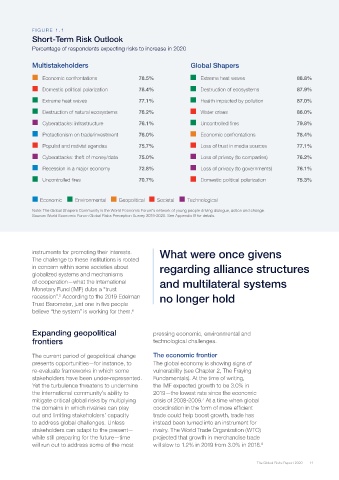
FIG U RE 1 .1
            Short-Term Risk Outlook
            Percentage of respondents expecting risks to increase in 2020

            Multistakeholders                                       Global Shapers

                Economic confrontations           78.5%                Extreme heat waves                88.8%

                Domestic political polarization   78.4%                Destruction of ecosystems         87.9%
                Extreme heat waves                77.1%                Health impacted by pollution      87.0%

                Destruction of natural ecosystems   76.2%              Water crises                      86.0%
                Cyberattacks: infrastructure      76.1%                Uncontrolled fires                 79.8%

                Protectionism on trade/investment   76.0%              Economic confrontations           78.4%
                Populist and nativist agendas     75.7%                Loss of trust in media sources    77.1%

                Cyberattacks: theft of money/data   75.0%              Loss of privacy (to companies)    76.2%
                Recession in a major economy      72.8%                Loss of privacy (to governments)   76.1%

                Uncontrolled fires                 70.7%                Domestic political polarization   75.3%


               Economic    Environmental   Geopolitical  Societal  Technological

            Note: The Global Shapers Community is the World Economic Forum’s network of young people driving dialogue, action and change.
            Source: World Economic Forum Global Risks Perception Survey 2019-2020. See Appendix B for details.


            instruments for promoting their interests.   What were once givens
            The challenge to these institutions is rooted
            in concern within some societies about       regarding alliance structures
            globalized systems and mechanisms
            of cooperation—what the International        and multilateral systems
            Monetary Fund (IMF) dubs a “trust
            recession”.  According to the 2019 Edelman   no longer hold
                      5
            Trust Barometer, just one in five people
            believe “the system” is working for them. 6


            Expanding geopolitical                     pressing economic, environmental and
            frontiers                                  technological challenges.

            The current period of geopolitical change   The economic frontier
            presents opportunities—for instance, to    The global economy is showing signs of
            re-evaluate frameworks in which some       vulnerability (see Chapter 2, The Fraying
            stakeholders have been under-represented.   Fundamentals). At the time of writing,
            Yet the turbulence threatens to undermine   the IMF expected growth to be 3.0% in
            the international community’s ability to   2019—the lowest rate since the economic
            mitigate critical global risks by multiplying   crisis of 2008-2009.  At a time when global
                                                                        7
            the domains in which rivalries can play    coordination in the form of more efficient
            out and limiting stakeholders’ capacity    trade could help boost growth, trade has
            to address global challenges. Unless       instead been turned into an instrument for
            stakeholders can adapt to the present—     rivalry. The World Trade Organization (WTO)
            while still preparing for the future—time   projected that growth in merchandise trade
            will run out to address some of the most   will slow to 1.2% in 2019 from 3.0% in 2018. 8


                                                                                           The Global Risks Report 2020  11

